
JIB CRANES
Jib crane: a fixed lifting area at one workstation
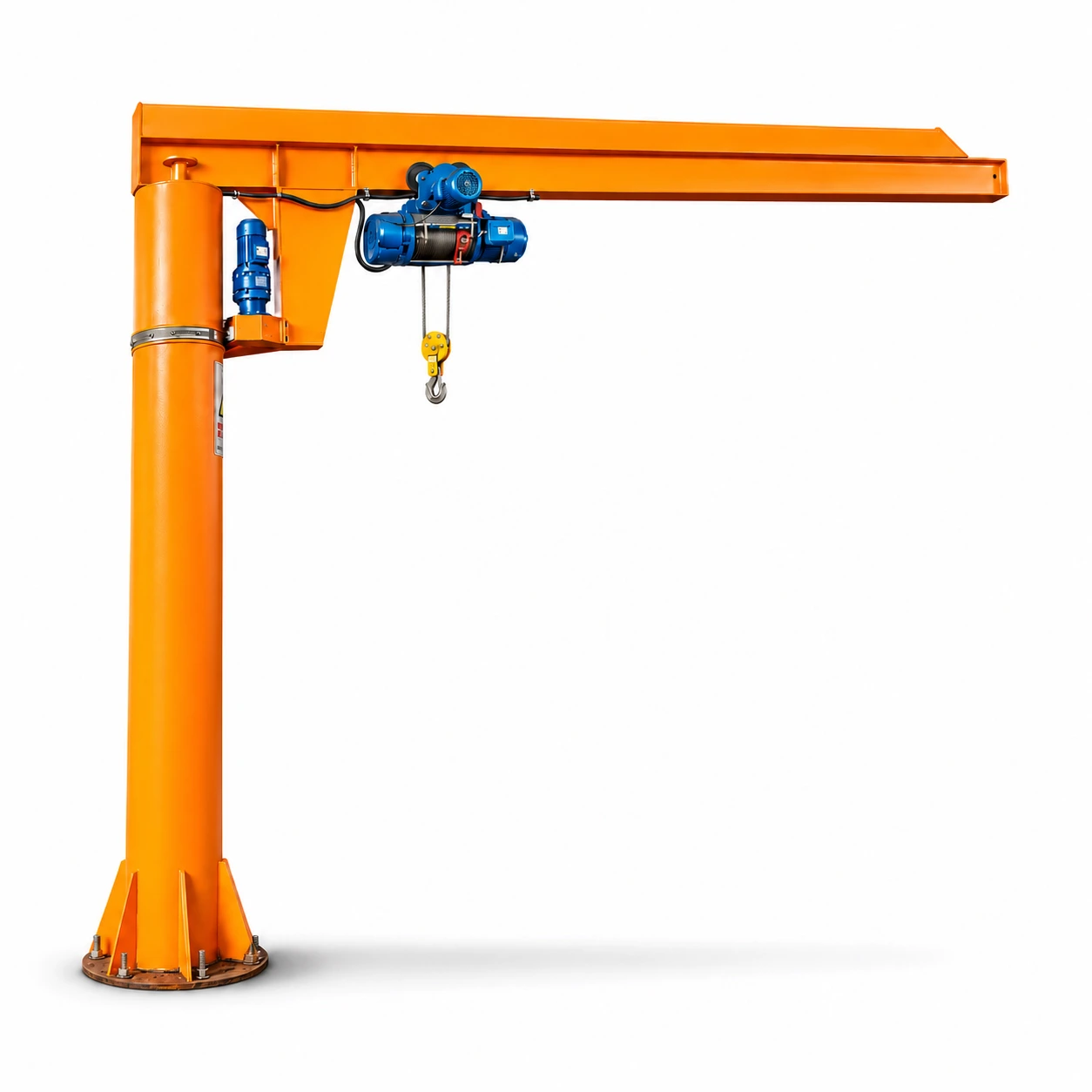
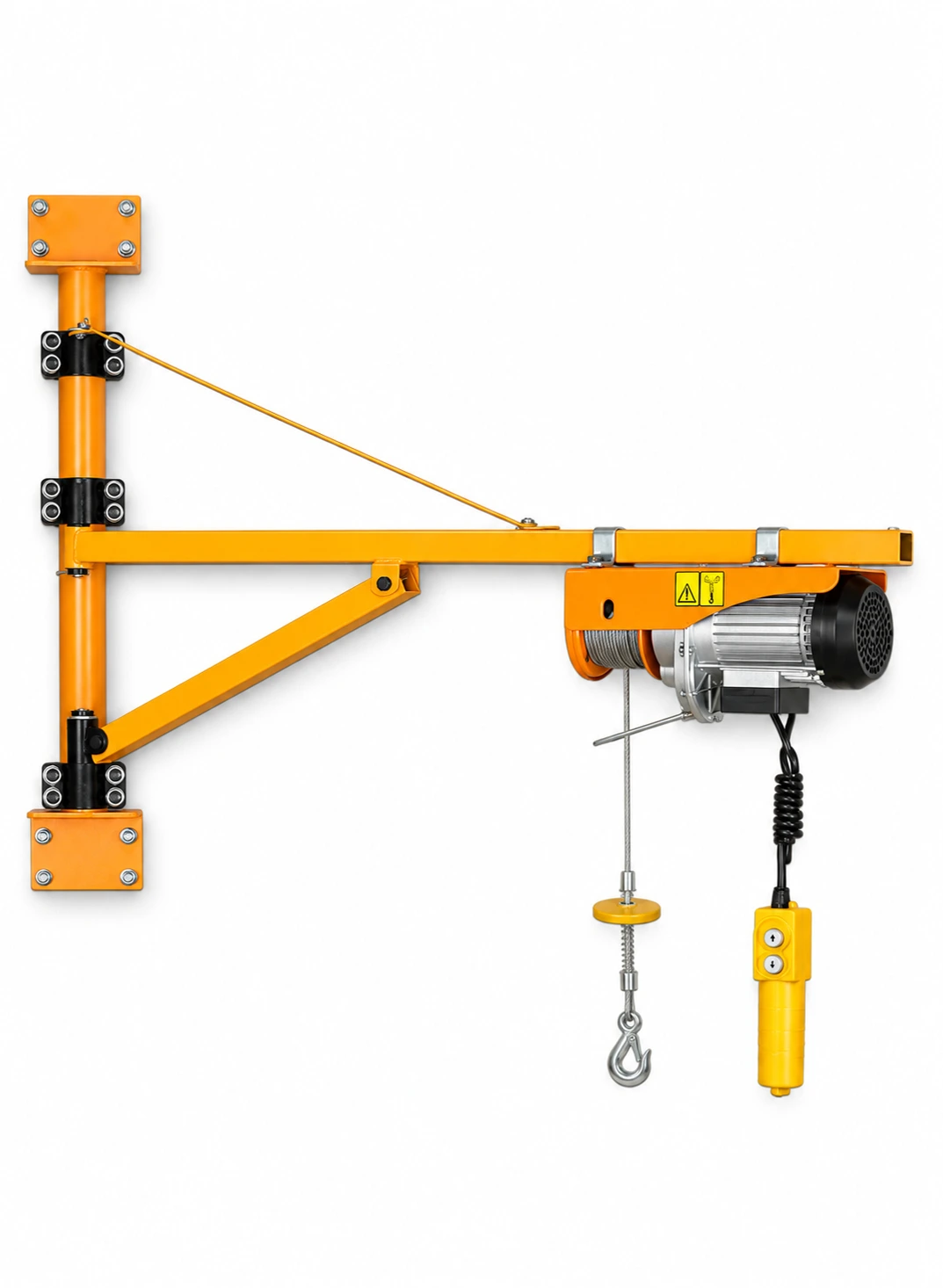
A jib crane serves one workstation. An arm rotates around a fixed mounting, and a hoist runs along the arm, so the lifting area is a circle (pillar) or a part-circle (wall-mounted) rather than a whole bay. The mounting decides most of the project: a pillar carries the load through a foundation, a wall bracket carries it into the building structure.
IN THIS FAMILY
Members of this family
Pillar or wall-mounted, how reach and rotation set the arm, what the installation depends on, and the data to send.
First decision: the mounting
The two jib forms do the same job with different support. Choose the mounting before the arm, because the mounting decides what has to be built, what has to be checked, and who owns the structural design.
| Question | Pillar jib (floor mounted) | Wall-mounted jib (bracket) |
|---|---|---|
| Where the load goes | Down the pillar into a foundation or a prepared floor slab | Into the wall or column through a bracket and, on some forms, a tie rod |
| What has to exist first | A foundation or slab designed for the overturning moment, and space for the base | A wall or column that can carry the bracket loads, and a clear height for the tie rod where one is used |
| Working area | Full rotation around the pillar, limited only by what stands in the circle | Rotation limited by the wall, the bracket and the tie rod arrangement |
| What it asks of the site | Floor space at the base, and foundation work | No floor space at the base, but the building structure becomes part of the design |
| What to confirm in the quotation | Foundation loads and the anchor arrangement, base plate, rotation drive or manual rotation | Bracket and anchorage design, wall capacity assumed, rotation limits, tie-rod arrangement |
Neither mounting is decided by preference alone. If the floor cannot take a foundation, or the wall cannot take a bracket, that is the answer — the other form is the project.
Reach, rotation and headroom set the arm
A jib is bought for a working area, not for a capacity alone. Measure the area first, then read the arm length off it.
- The furthest point the hook has to reach, measured horizontally from the mounting centre — not from the nearest wall.
- The nearest point, because the hoist and trolley have their own body depth and cannot always reach the mounting.
- Rotation needed: a full circle, or a sector limited by a wall, a pipe run or a walkway.
- Hook height at the highest pick, and the headroom above the arm for the hoist body at its highest position.
- Clearance under the arm at the lowest hook position, including the load and the sling.
- Obstructions in the swept area: columns, services, doors, forklift routes, and anything a swinging load could reach.
A jib that reaches the far corner but cannot rotate past a pipe run is a shorter jib with a worse layout. Walk the swept area before fixing the arm length.
What the installation depends on
The jib is the part that is quoted; the installation is the part that decides whether it works. Three items are always project-specific.
- Foundation or wall capacity: the loads a jib applies are not only vertical. Overturning and pull-out have to be carried by something that was designed for them.
- Anchorage: the anchor type, the edge distance and the condition of the concrete or steel it goes into belong to the installation design, not to a generic fixing schedule.
- Rotation and travel limits: whether the arm is free to rotate, geared or manual, and what stops it at the end of the sector.
- Power and control: where the supply comes from, whether the hoist travels with a festoon or a conductor run, and where the operator stands.
Ask who signs off the foundation or bracket design. If the answer is "the customer", that is a legitimate answer — but it has to be written down before the order, not discovered at installation.
What to send before a quotation
A jib enquiry can be answered from a sketch and a handful of values. Send what you have and mark what you do not; the missing items become questions rather than assumptions.
| Value | Why it changes the answer |
|---|---|
| The load, and how it is attached | Sets the hoist and the hook arrangement, and whether a spreader or sling is needed |
| Working radius to the furthest and nearest pick | Sets the arm length and whether the trolley can reach the mounting end |
| Rotation needed, and what limits it | Separates a pillar jib from a wall bracket, and sets the stops |
| Hook height and headroom | Sets the arm height and the hoist body position |
| Floor or wall details | Decides which mounting can be built, and what the foundation or bracket design has to carry |
| Power supply and control position | Sets the hoist supply, the festoon or conductor run, and the control arrangement |
| Environment | Indoor, outdoor, wash-down or dusty: it changes the enclosure, the finish and the inspection points |
| Delivery country or region | Sets the documentation, the power arrangement and the packing |
What the quotation should state
- Which mounting form is proposed, and what structural design it assumes
- The arm length, the rotation arrangement and the stops
- The hoist, trolley and control package, and what is excluded
- The foundation or bracket loads, and who designs and approves them
- The documents: dimensional drawing, installation instructions, operating limits
- Packing, delivery terms and the works each party performs
The site values a jib enquiry depends on, and the eight items that explain a difference between two offers, are collected on the crane planning worksheet.
LET'S DISCUSS YOUR JOB
Planning a jib crane for one workstation?
Send the load, the working radius and the floor or wall details. We can point out which mounting question decides the rest.
WhatsApp our team ↗Or email our team directly. If the form does not load, use email or WhatsApp.
COMMON QUESTIONS
Questions about jib cranes
Pillar or wall-mounted: which one should I choose?
Start with what the building can carry. A pillar jib needs a foundation or a slab designed for the overturning moment and takes floor space at the base. A wall-mounted jib needs a wall or column that can carry the bracket, and it gives up some rotation. If either support is doubtful, that usually decides the form.
Can one jib cover two workstations?
Only if both sit inside the swept area of the same arm and the arm can reach both at the height each job needs. Stretching the arm to cover a second position increases the loads on the mounting and reduces what the hoist can lift at the far end. Compare a longer arm against a second jib before ordering.
Who designs the foundation or the wall bracket?
That is settled per project and should be written into the quotation. Some suppliers include the foundation or bracket design; others supply the loads and leave the structural design to the customer's engineer. Neither is wrong, but the scope has to be explicit before installation starts.
Does the hoist come with the jib?
The hoist, trolley and control package are part of the same quotation when the jib is bought as a working unit, and they can be excluded when a hoist already exists. This page describes the arrangement, not a fixed package: the scope of supply is stated in the quotation for your project.