technical · 7 min read · Engineering Team
Overhead Crane Inspection Checklist (Monthly / Annual)
A crane that is inspected on a fixed schedule and maintained against a written plan stays in service. One that is only inspected after a fault develops does not. This checklist sets out a practical daily, monthly and annual structure, what to look at in each period, and the point at which a check has to stop and become a repair. It does not replace the manufacturer's manual, the erection drawing or the inspection required by the regulations that apply at your site.
The short answer
Operators check the crane before each shift. A competent person inspects it monthly against a written list, and carries out a more detailed annual inspection including electrical and structural items, followed by a load test where the applicable standard or local regulation requires one. Anything that affects the hoist brake, the load path or the lifting attachment takes the crane out of service immediately.
Before each shift (operator check)
- Hoist brake — a short test lift with a load, checking that the brake holds without drift.
- Limit switches — confirm the upper and lower hoist limits and the travel limits operate.
- Emergency stop — operated once to confirm it stops the motion, then reset.
- Wire rope — visible broken wires, kinks, flattening, corrosion, or rope wandering off the drum.
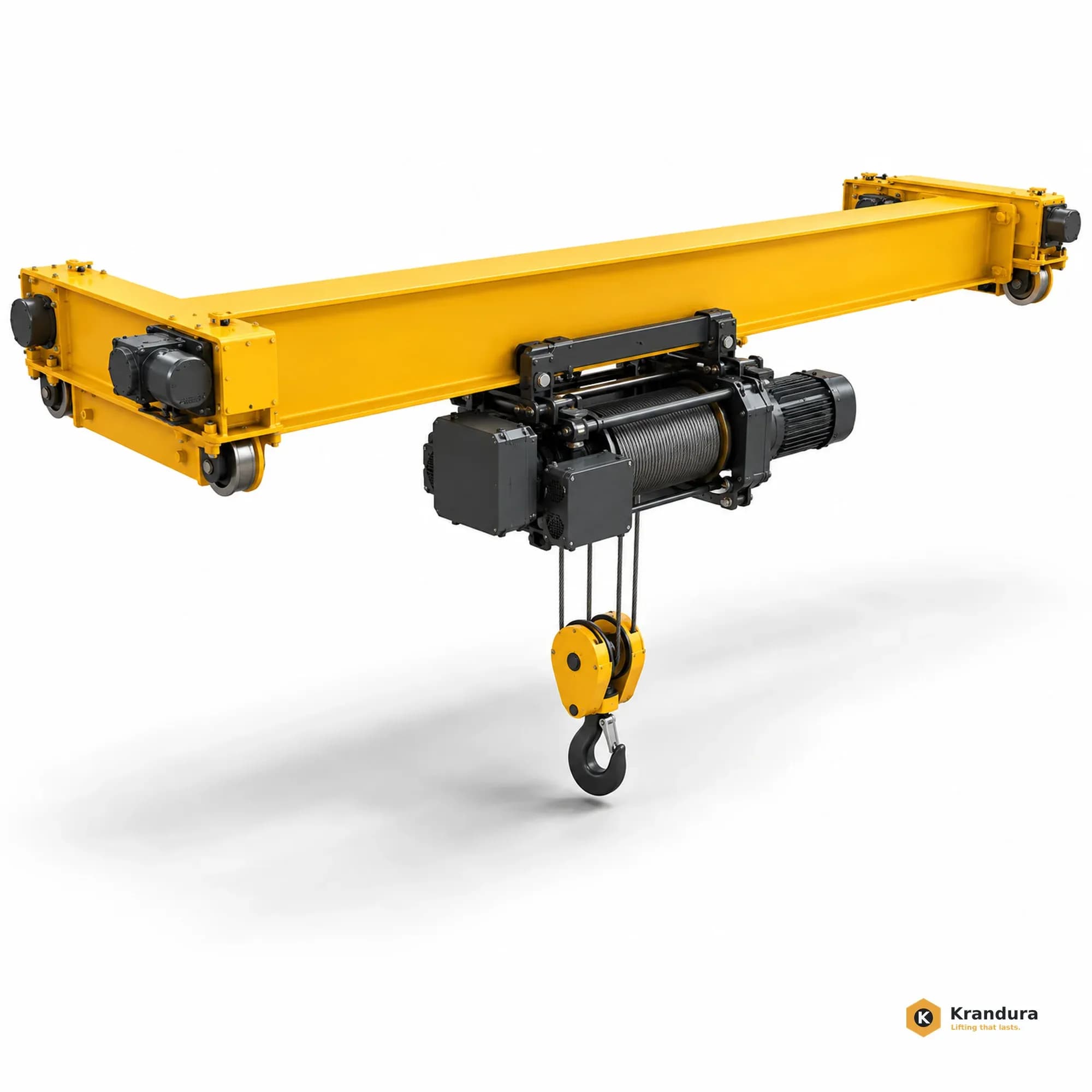
- Hook — deformation, cracks at the shank, a working safety latch, notation that the hook can rotate freely.
- Slings and attachments — the correct ones for the load, with a legible capacity mark and no visible damage.
- Controls and pendant — the pendant cable or radio response, and any button that does not return.
- Abnormal noise, vibration or smell anywhere along the travel.
Monthly inspection (competent person)
Hoisting and load path
- Wire rope condition measured and recorded, including the position of the rope in the drum grooves and at the equaliser if fitted.
- Rope guide, sheaves and the drum for wear, alignment and correct rotation.
- Hook and hook block: wear on the saddle, the thread or pin, the safety latch and rotation.
- Brake adjustment, lining thickness and the gap between the lining and the drum or disc.
- Gearbox oil level and visible leakage; lubrication points done to the schedule.
Structure and travel
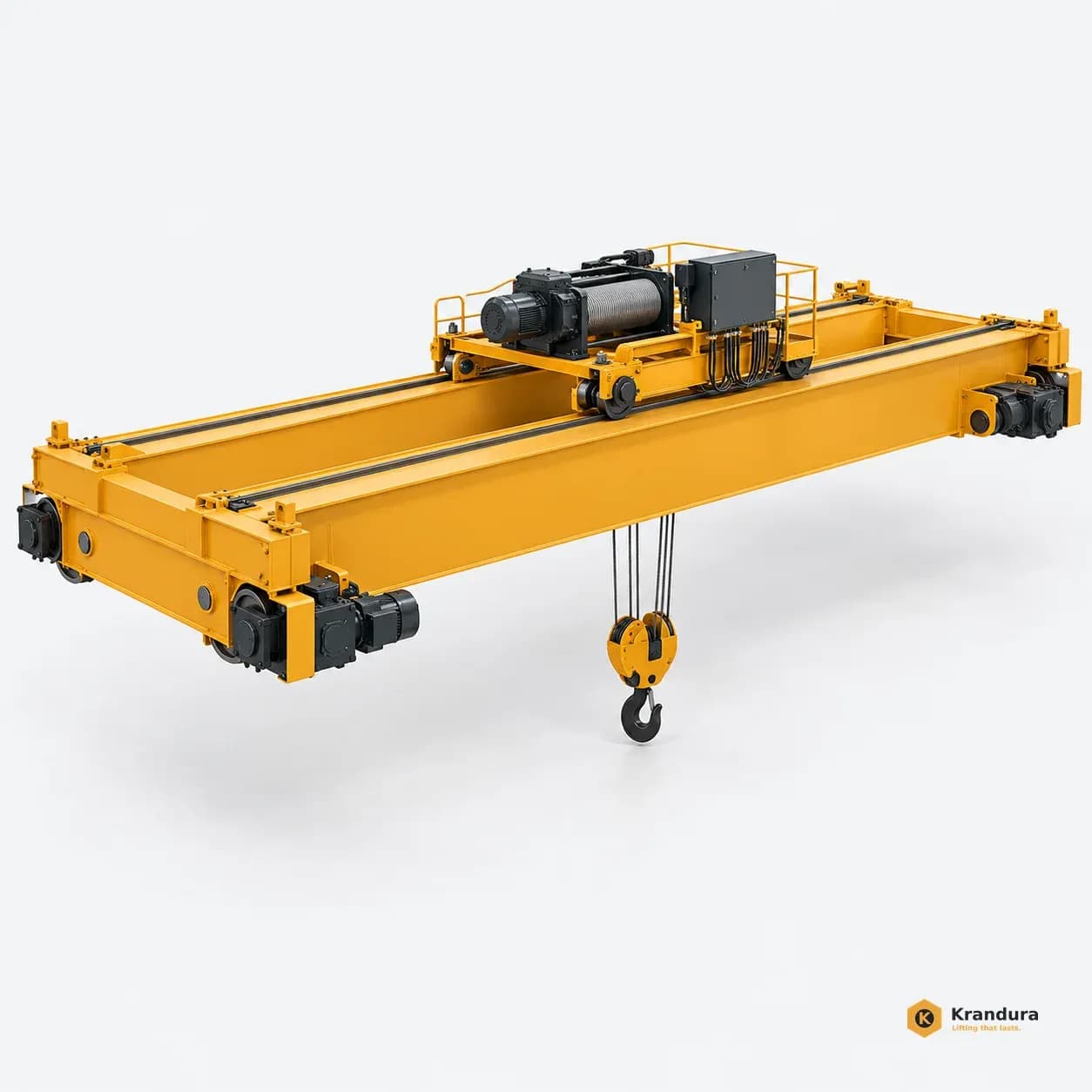
- Main girders, end carriages, connections and welds for cracks, deformation or loose bolts.
- Wheel flanges and treads, wheel alignment and the condition of the rail running surface.
- Runway rails, clips and joints; check for loose clips and steps at the joints.
- End stops, buffers and rail sweeps present, secure and undamaged.
- Walkways, platforms, ladders, handrails and guards secure.
- Festoon system or conductor bar: trolleys running freely, cable or bar undamaged, no snagging.
Electrical and control
- Control panel cleaned, with no sign of overheating, water ingress or loose terminals.
- Contactors, relays and drives inspected for pitting, arcing or discolouration.
- All safety-related switches and interlocks tested: limits, overload, anti-collision where fitted.
- Insulation resistance of the main circuits measured and recorded against the previous reading.
- Emergency stop circuits verified, and the emergency lowering or release procedure still valid.
- Pendant cable or radio transmitter condition, battery and signal reliability.
Annual inspection and load test
- Structural inspection of the load-bearing members, including the runway, with attention to connection details.
- Brake overhaul or replacement according to wear, and a functional test at rated load.
- Wheel, bearing and gearbox inspection with the crane at the extremes of travel.
- Complete electrical inspection, including protection settings and the correct operation of every interlock.
- Wire rope replacement assessment against the discard criteria in the applicable standard.
- Load test at the rated load, and at the proof load where the applicable standard or local regulation requires it.
- Review of the maintenance history to identify items that are wearing faster than expected.
When the crane must come out of service
- The hoist brake does not hold the load, or the stopping distance has increased noticeably.
- The wire rope reaches the discard criteria: broken wires, diameter reduction, corrosion, kinking or a broken strand.
- The hook is deformed, cracked, or the safety latch is missing or inoperative.
- Any crack, deformation or loose connection is found in a load-bearing member.
- An emergency stop, limit switch or overload device does not operate.
- Any abnormal noise, vibration, smoke or smell during operation, until the cause is identified.
Keeping records that are worth having
Record what was checked, what was found, what was done and by whom, with dates. A running record turns a list of inspections into a maintenance plan: a rope that is wearing faster than expected, a brake that keeps needing adjustment or a rail joint that keeps loosening are all visible in the history before they become a failure. Where the regulations that apply at your site require inspection by a competent or statutory person, keep those reports with the same record.
Where this checklist stops
This is a practical structure for a general overhead crane. Lifting equipment in hazardous duty — molten metal, hot loads, explosives, or any application where the consequences of a dropped load are severe — needs an inspection programme written for that case, and the intervals and criteria must come from the applicable standard and the crane manufacturer, not from a general-purpose list.