guide · 7 min read · Engineering Team
How Much Does a 20 Ton Overhead Crane Cost?
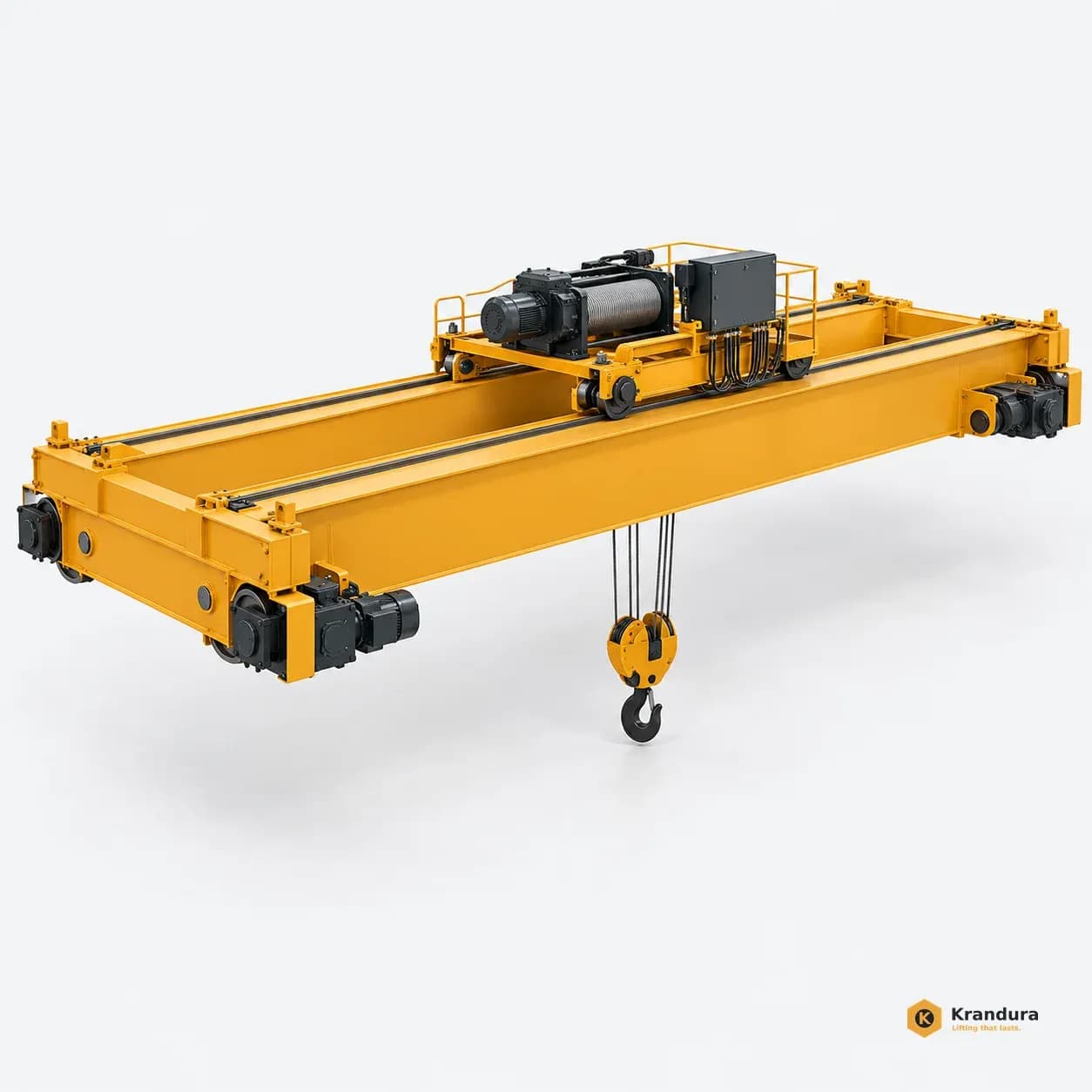
A 20 ton overhead crane has no single list price. Two cranes with the same lifting capacity can differ by a factor of two once span, lift height, duty class, hoist type, control system and destination are fixed. This guide explains what actually moves the number, how to compare two quotations fairly, and which items are usually excluded.
The short answer
Cost is set by the machine you specify, not by the tonnage. Capacity is only the starting point: the same 20 t crane at 16 m span and 6 m lift, running 500 hours a year, is a much lighter machine than a 20 t crane at 30 m span and 12 m lift running a heavy duty cycle. When you compare offers, compare the specification behind the price before the price itself.
What drives the price
- Span. Span has the largest effect on structure. As the span grows, the girder has to resist a larger bending moment and stiffness becomes a bigger constraint, so the girder deepens and the crane gets heavier. The runway beams, columns and foundations grow with it. A span increase of a few metres can move the structural cost more than a capacity step.
- Lift height. Lift height drives rope length, drum size, reeving, cable length, festoon or conductor-bar runs and the height of the end carriages. Above about 12–15 m the drum and reeving change shape, not just size.
- Duty class. The classification (FEM 1.001 or ISO 4301, expressed as a class such as M4–M8) sets how the motor, brake, gearbox, bearings and structure are rated. Moving from a light to a heavy class usually means a larger hoist, a stronger frame and a higher-specification brake. It is one of the most frequently underestimated cost drivers, because the buyer often quotes the previous crane's duty class without recalculating it.
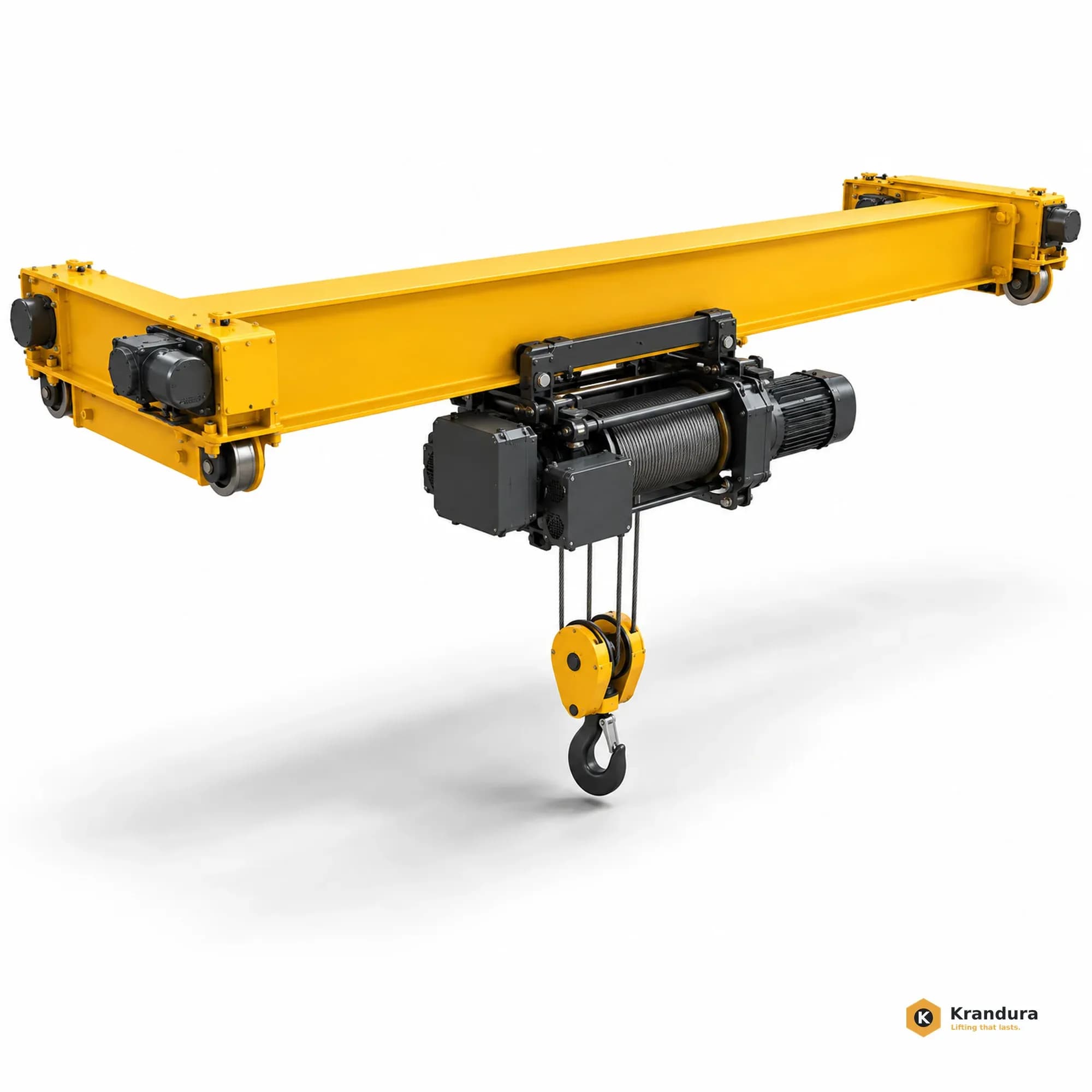
- Hoist type. A standard wire rope hoist, a compact "European" hoist and a heavy-duty foundry or ladle hoist sit in different price bands. The differences are real: dimensions, lifting speeds, brake architecture, thermal capacity and the amount of maintenance access built in.
- Headroom and hook approach. Cranes designed to lift the hook very close to the girder or to the runway need a different hoist arrangement and often a larger structure. Tight headroom is a specification, not an accessory.
- Control and electrical specification. Pendant, radio, cabin, dual-speed versus variable-frequency drives, festoon versus conductor bar, isolation and panel protection all move the price. Variable-frequency control in particular changes both the drive cost and the behaviour of the crane under load.
- Environment. Outdoor, dusty, humid or corrosive service changes the enclosure rating, paint system, cable insulation, lubrication and the frequency of the maintenance plan.
- Attachments. A magnet, C-hook, spreader beam, grab or rotating hook changes the load case and usually the hoist and reeving as well.
- Quantity and standardisation. Two or three identical cranes are cheaper per unit than three different ones, because the engineering, the tooling and the spares list are shared.
What a crane package normally covers
Prices are only comparable if the scope is the same. A bridge and hoist quotation usually includes the crane structure, hoist, end carriages, travel drives, the control system, the pendant or radio, and the documentation and test certificate. It usually does not include:
- Runway beams, columns, brackets and any modification to the building structure.
- Civil works, foundations and anchor bolts, including the gantry track foundation where relevant.
- Power supply to the crane isolation point, cabling from the panel, earthing and lightning protection.
- Freight, marine insurance, import duties, port charges and inland transport.
- Erection, commissioning, load testing on site and operator training, unless quoted separately.
- Wearing parts beyond the initial set and anything not listed as an optional in the offer.
When two quotations differ, put them side by side on these items first. A gap of a few percent in the crane price is easy to create by moving scope out of the offer.
How to compare two quotations
- Check the capacity, span and lift height match exactly — including whether lift height is measured to the hook or to the top of the load.
- Check the duty class is stated and explained, and that both offers use the same classification system.
- Compare hoisting speeds, and whether the specified speed applies to the full load or only at partial load.
- Compare the hoist, brake and motor brand and protection class. Component brands explain a large part of a price difference and a large part of the durability difference.
- Compare what happens at the site: who provides the runway, the power supply, the erection and the load test.
- Compare documentation: drawings, load test certificate, electrical schematics, spare parts list and manuals, and the language they are issued in.
- Compare lead time against the same starting point (order versus deposit), and confirm how the delivery date is defined.
Common mistakes
- Designing the crane around a target price instead of the duty, then discovering the duty class was too low.
- Quoting the span from the building drawing without checking the actual clear dimension between the runway rails.
- Assuming the previous crane's duty class still applies after a production increase.
- Forgetting that a higher capacity does not automatically mean a longer reach: a bigger crane can have less hook approach.
- Comparing prices before aligning the scope, then concluding that the offers are inconsistent when they are simply different.
How to get a usable quotation
Send capacity, span, lift height, duty or cycles per hour, what is being lifted, indoor or outdoor conditions, power supply and destination port. With those seven items, a supplier can quote the same machine rather than an approximation — and you can compare responses directly. If some values are not settled yet, say so: an offer that names its assumptions is more useful than one that hides them.